
- This event has passed.
230-NASA – The Challenge to Fix Hubble’s Best Survey Camera
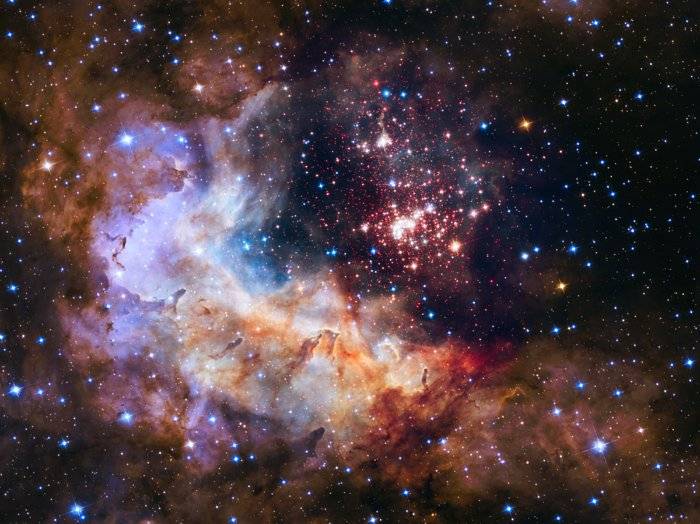
This NASA/ESA Hubble Space Telescope image of the cluster Westerlund 2 and its surroundings has been released to celebrate Hubble’s 25th year in orbit and a quarter of a century of new discoveries, stunning images and outstanding science.
The image’s central region, containing the star cluster, blends visible-light data taken by the Advanced Camera for Surveys and near-infrared exposures taken by the Wide Field Camera 3. The surrounding region is composed of visible-light observations taken by the Advanced Camera for Surveys.
Shortly after NASA Administrator Michael Griffin announced that NASA would add a servicing mission to the Hubble Space Telescope, Hubbles most prominent camera and most used instrument, died.
The incredible engineering challenge to understand the problem, develop a strategy to fix ACS that astronauts could perform, create the tools and new circuit board components in an incredibly short time, could not have been accomplished it the Space Telescope Imaging Spectrograph (STIS) hadnt failed a few years ealier. Goddard Engineers leveraged techniques they developed for STIS repair to fix ACS.

The NASA/ESA Hubble Space Telescope has snapped the best ever image of the Antennae Galaxies. Hubble has released images of these stunning galaxies twice before, once using observations from its Wide Field and Planetary Camera 2 (WFPC2) in 1997, and again in 2006 from the Advanced Camera for Surveys (ACS). Each of Hubble’s images of the Antennae Galaxies has been better than the last, due to upgrades made during the famous servicing missions, the last of which took place in 2009.

This stunning image of NGC 1275 was taken using the NASA/ESA Hubble Space Telescope’s Advanced Camera for Surveys in July and August 2006. It provides amazing detail and resolution of the fragile filamentary structures, which show up as a reddish lacy structure surrounding the central bright galaxy NGC 1275. These filaments are cool despite being surrounded by gas that is around 55 million degrees Celsius hot. They are suspended in a magnetic field which maintains their structure and demonstrates how energy from the central black hole is transferred to the surrounding gas.