
- This event has passed.
229-NASA – Update: Hubble SM4 Flight Day 2
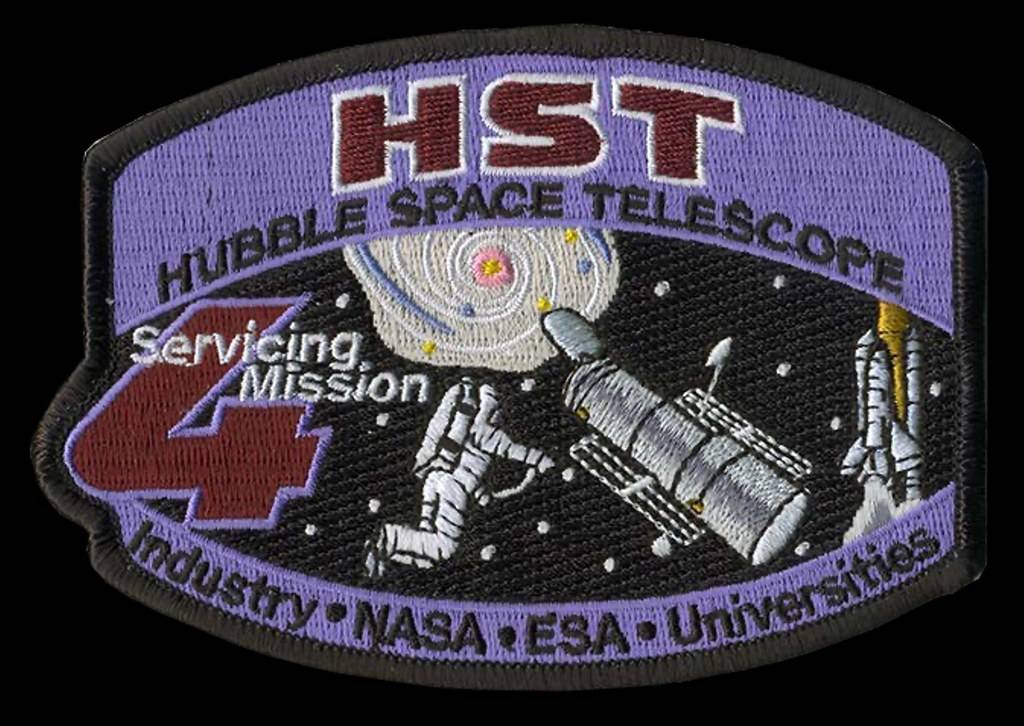
The Hubble Space Telescope was reborn with Servicing Mission 4 (SM4), the fifth and final servicing of the orbiting observatory. During SM4, astronauts installed two new scientific instruments – the Cosmic Origins Spectrograph (COS) and Wide Field Camera 3 (WFC3). Two failed instruments, the Space Telescope Imaging Spectrograph (STIS) and the Advanced Camera for Surveys (ACS), were brought back to life by the first ever on-orbit repairs. These efforts brought Hubble to the apex of its scientific capabilities.
To prolong Hubble’s life, astronauts installed new batteries, new gyroscopes, a new science computer, a refurbished fine guidance sensor, and new insulation on three electronics bays. Additionally, astronauts attached a device to the base of the telescope that will facilitate de-orbiting when the telescope is eventually decommissioned.

These seven astronauts took a break from training to pose for the STS-125 crew portrait. From the left are astronauts Michael J. Massimino and Michael T.Good, both mission specialists; Gregory C. Johnson, pilot; Scott D. Altman, commander; K. Megan McArthur, John M. Grunsfeld and Andrew J. Feustel, all mission specialists. The STS-125 mission was the final space shuttle mission to the Hubble Space Telescope. NASA
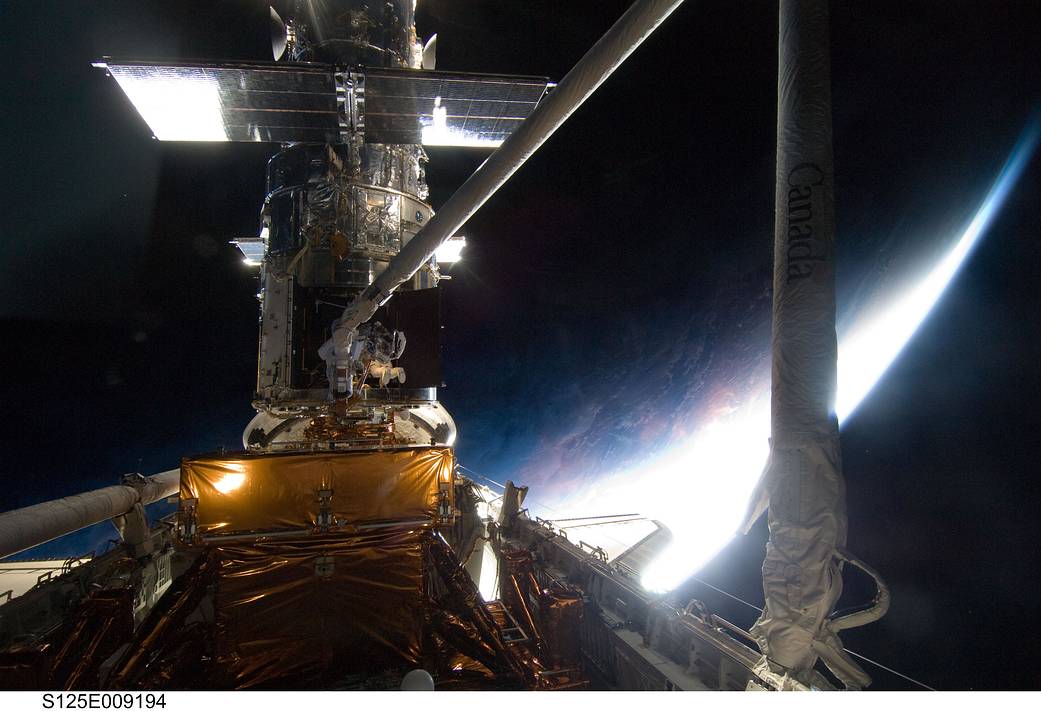
With a mostly dark home planet behind him, STS-125 mission specialist Michael Good rides Atlantis’ remote manipulator system arm to where he needs be while working on the Hubble Space Telescope. Credit: NASA
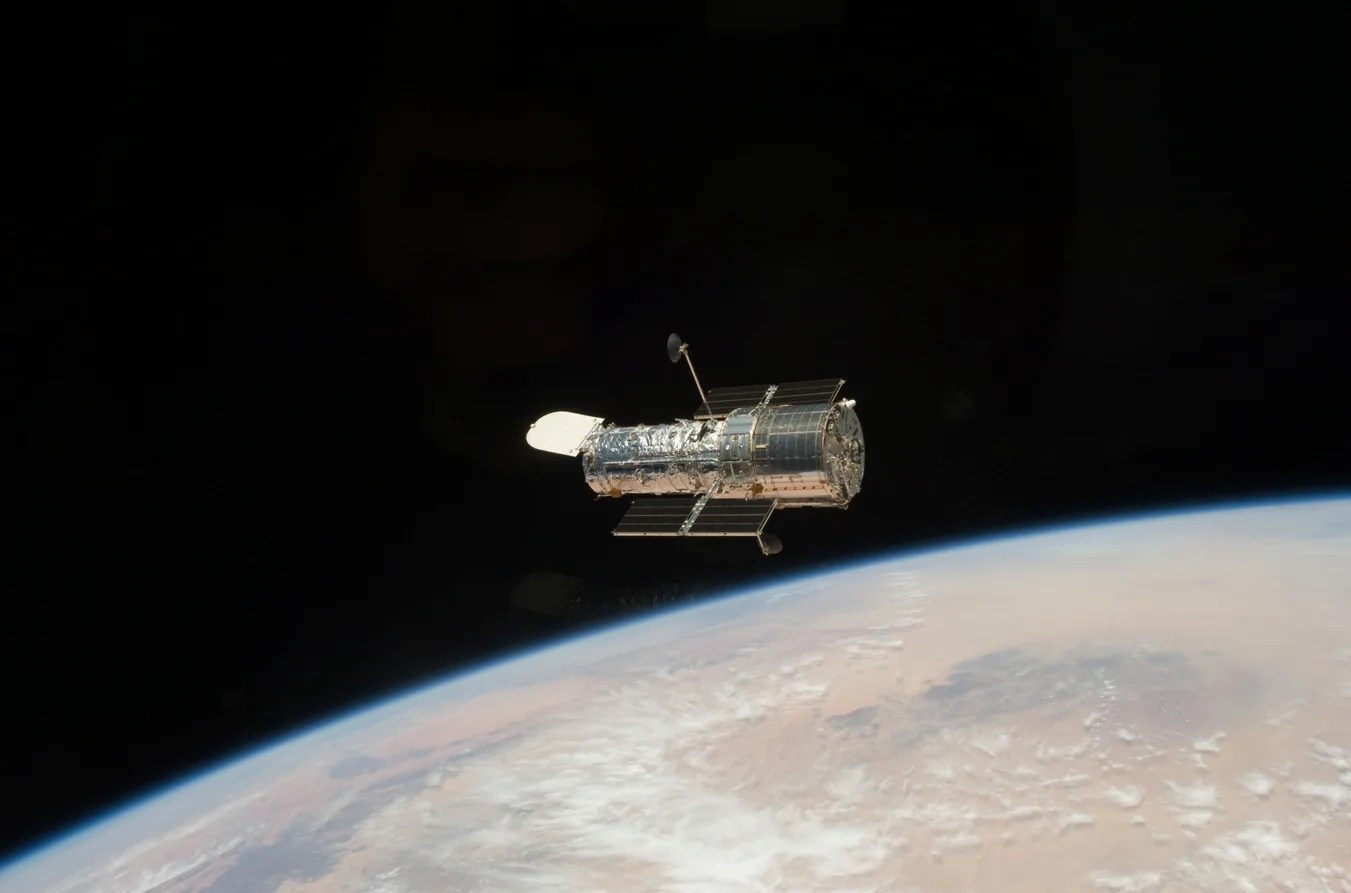
The Hubble Space Telescope as seen from the space shuttle Atlantis (STS-125) in May 2009, during the fifth and final servicing of the orbiting observatory.
NASA
Updated April 30, 2024
-
Editor’s note:
On April 30, 2024, NASA announced it restored the agency’s Hubble Space Telescope to science operations April 29. The spacecraft is in good health and once again operating using all three of its gyros. All of Hubble’s instruments are online, and the spacecraft has resumed taking science observations.
Published April 26, 2024
NASA is working to resume science operations of the agency’s Hubble Space Telescope after it entered safe mode April 23 due to an ongoing gyroscope (gyro) issue. Hubble’s instruments are stable, and the telescope is in good health.
The telescope automatically entered safe mode when one of its three gyroscopes gave faulty readings. The gyros measure the telescope’s turn rates and are part of the system that determines which direction the telescope is pointed. While in safe mode, science operations are suspended, and the telescope waits for new directions from the ground.
This particular gyro caused Hubble to enter safe mode in November after returning similar faulty readings. The team is currently working to identify potential solutions. If necessary, the spacecraft can be re-configured to operate with only one gyro, with the other remaining gyro placed in reserve . The spacecraft had six new gyros installed during the fifth and final space shuttle servicing mission in 2009. To date, three of those gyros remain operational, including the gyro currently experiencing fluctuations. Hubble uses three gyros to maximize efficiency, but could continue to make science observations with only one gyro if required.
NASA anticipates Hubble will continue making groundbreaking discoveries, working with other observatories, such as the agency’s James Webb Space Telescope, throughout this decade and possibly into the next.
Launched in 1990, Hubble has been observing the universe for more than three decades and recently celebrated its 34th anniversary. Read more about some of Hubble’s greatest scientific discoveries and visit nasa.gov/hubble for updates.