
280-NASA – Mars Evolution
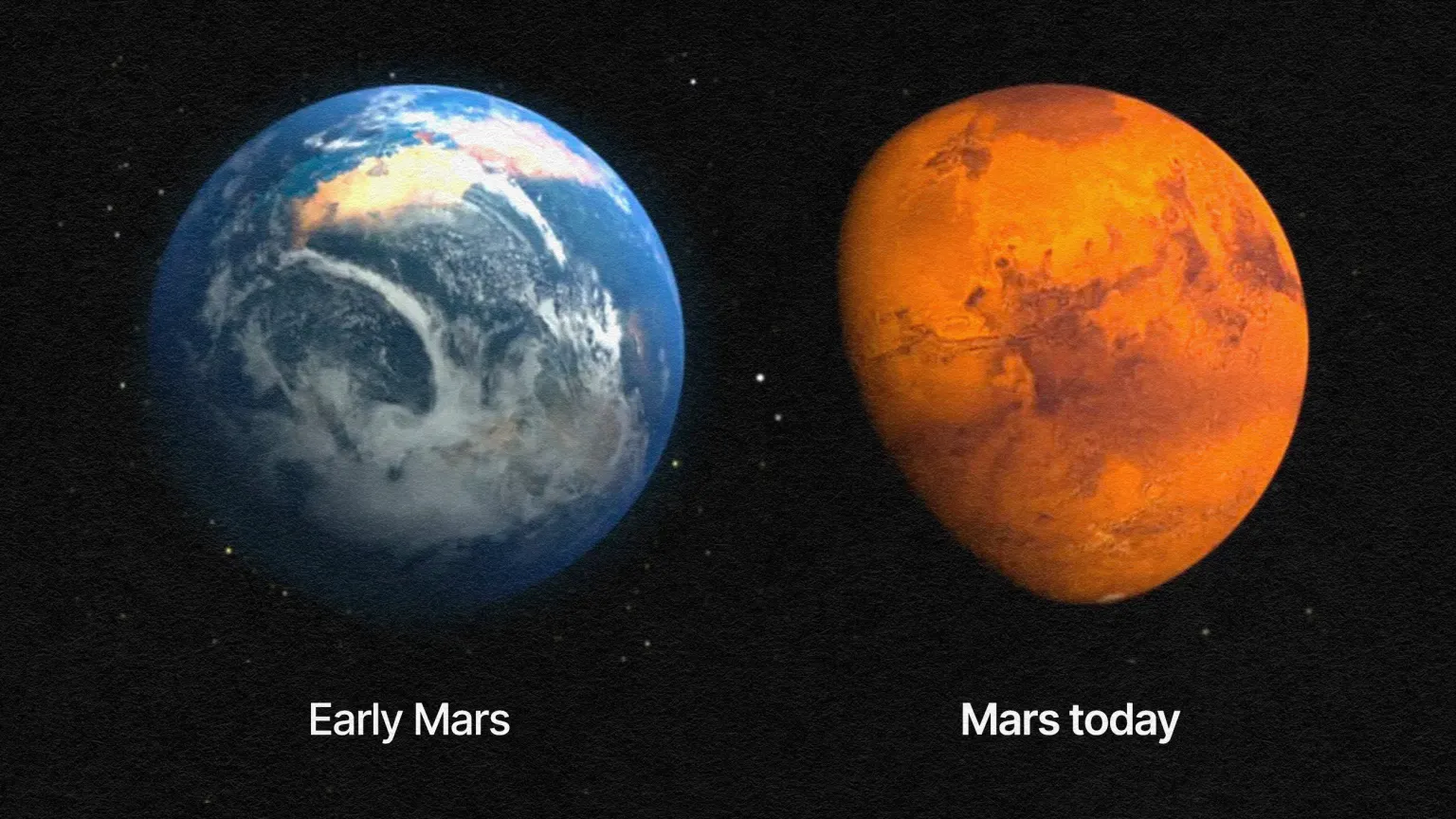
Shortly after the Solar System’s formation, three of the inner planets — Venus, Earth, and Mars — had the right ingredients, as well as the right conditions, for life to arise and thrive on that world. On Earth, life arose very early on and has survived ever since in an unbroken chain, but Venus died relatively quickly, and Mars died after about 1.5 billion years, both for very different reasons.
Billions of years ago when the Red Planet was young, it appears to have had a thick atmosphere that was warm enough to support oceans of liquid water – a critical ingredient for life. The animation shows how the surface of Mars might have appeared during this ancient clement period, beginning with a flyover of a Martian lake. The artist’s concept is based on evidence that Mars was once very different. Rapidly moving clouds suggest the passage of time, and the shift from a warm and wet to a cold and dry climate is shown as the animation progresses. The lakes dry up, while the atmosphere gradually transitions from Earthlike blue skies to the dusty pink and tan hues seen on Mars today.

How Mars Lost Its Atmosphere and Became a Frigid Desert.

Recurring slope lineae, like this one on the south-facing slope of a crater on the floor of Melas Chasma, have not only been shown to grow over time and then fade away as the Martian landscape fills them in with dust, but are known to be caused by the flowing of briny, liquid water, as the dried-up flows leave new trails of salts behind. In those flows, life processes not only once occurred, but perhaps are still occurring today as dormant organisms are awakened by flowing liquid water.