
- This event has passed.
265-TESS Catches its First Star-destroying Black Hole
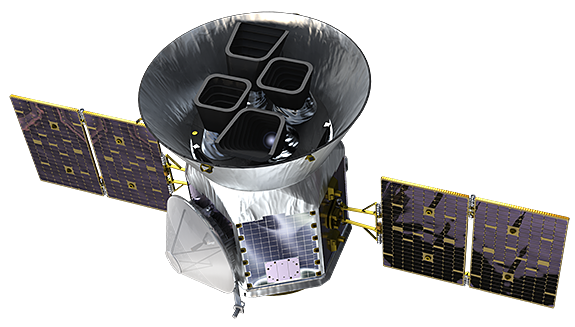
The Transiting Exoplanet Survey Satellite (TESS) is an MIT-led NASA mission to spend two years discovering transiting exoplanets by an all-sky survey.
TESS has four identical, highly optimized, red-sensitive, wide-field cameras that together can monitor a 24 degree by 90 degree strip of the sky. By monitoring each strip for 27 days and nights, TESS will tile the southern hemisphere sky in the first year and the northern hemisphere sky in the second year. TESS is scheduled for launch no earlier than March 2018, aboard a SpaceX Falcon 9 rocket, and will go into a very eccentric, inclined orbit around the Earth. TESS will discover thousands of planets and is further specially designed to find a pool of small planets transiting small stars. TESS will deliver fifty rocky planets with measured masses for a lasting legacy. The TESS data has no proprietary time and the data segments will become public four months after observations.

For the first time, NASA’s planet-hunting Transiting Exoplanet Survey Satellite (TESS) watched a black hole tear apart a star from start to finish, a cataclysmic phenomenon called a tidal disruption event.
The blast, named ASASSN-19bt, was found on Jan. 29 by the All-Sky Automated Survey for Supernovae (ASAS-SN), a worldwide network of 20 robotic telescopes. Shortly after the discovery, ASAS-SN requested follow-up observations by NASA’s Swift satellite, ESA’s (European Space Agency’s) XMM-Newton and ground-based 1-meter telescopes in the global Las Cumbres Observatory network.
The disruption occurred in TESS’s continuous viewing zone, which is always in sight of one of the satellite’s four cameras. This allowed astronomers to view the explosion from beginning to end.
This video shows images of a tidal disruption event called ASASSN-19bt taken by NASA’s Transiting Exoplanet Survey Satellite (TESS) and Swift missions, along with an animation illustrating how it unfolded. Because ASASSN-19bt occurred in the TESS continuous viewing zone, the satellite observed the full duration of the event.