
- This event has passed.
338-The Insane Engineering of the Perseverance Rover
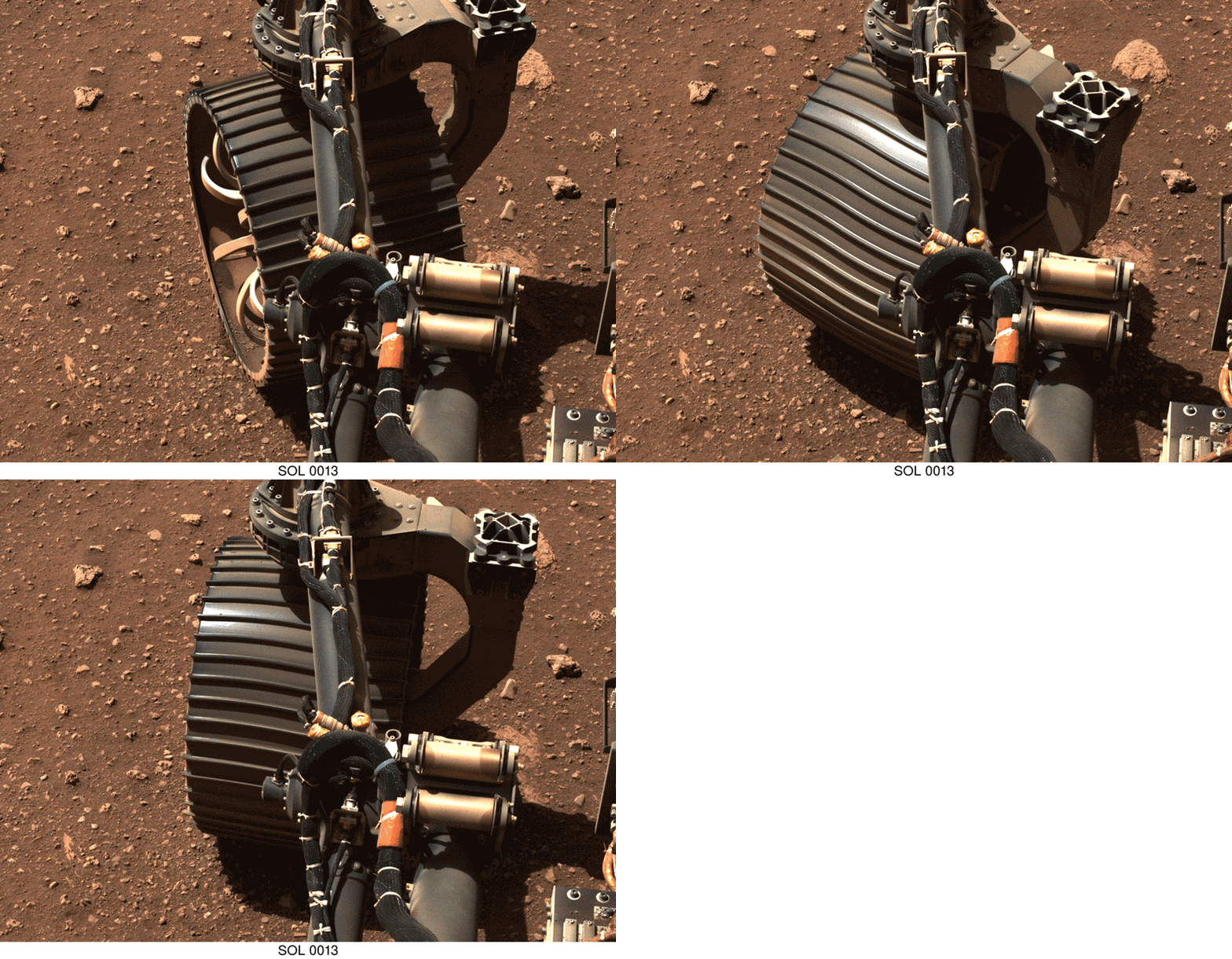
Views of Perseverance’s Wheels Wiggling: The animated GIFs show NASA’s Perseverance Mars rover wiggling its front left wheel on March 4, 2021, the day Perseverance completed its first drive on Mars. NASA/JPL-Caltech
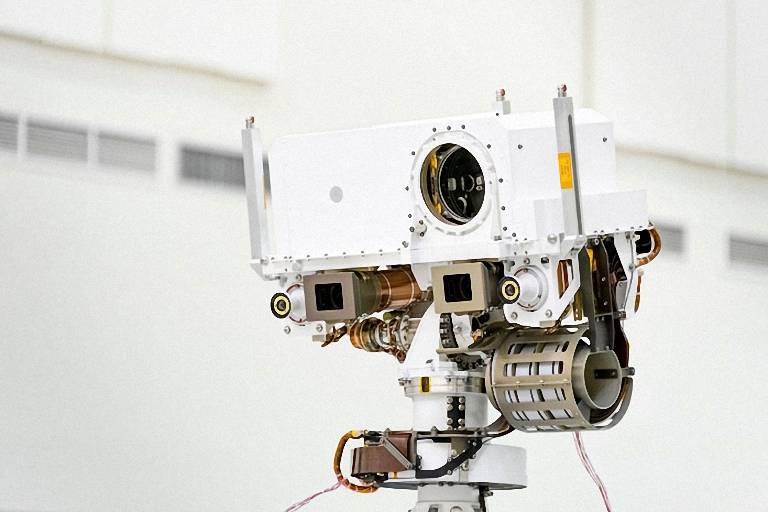
Neck and Head.
A mast for the cameras to give the rover a human-scale view.
This image, taken in the Spacecraft Assembly Facility’s High Bay 1 at the Jet Propulsion Laboratory in Pasadena, California, on July 23, 2019, shows a close-up of the head of Mars 2020’s remote sensing mast. The mast head contains the SuperCam instrument (its lens is in the large circular opening). In the gray boxes beneath mast head are the two Mastcam-Z imagers. On the exterior sides of those imagers are the rover’s two navigation cameras.
NASA/JPL-Caltech
The Rover’s “Body”
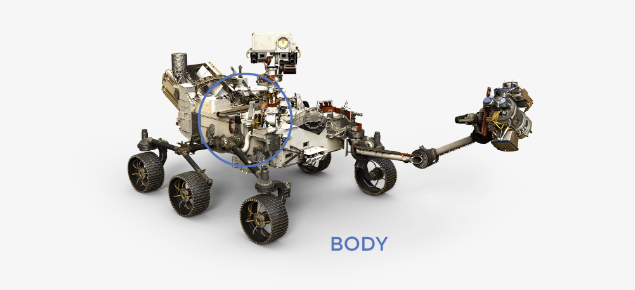
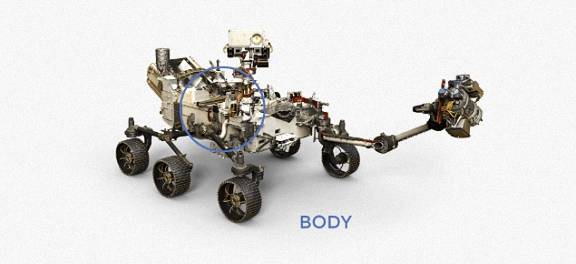
The Perseverance rover’s body is called the warm electronics box, or “WEB” for short. Like a car body, the rover body is a strong, outer layer that protects the rover’s computer and electronics (which are basically the equivalent of the rover’s brains and heart). The body keeps the rover’s vital organs protected and temperature-controlled.
The warm electronics box is closed on the top by a piece called the Rover Equipment Deck. The Rover Equipment Deck makes the rover like a convertible car, allowing a place for the rover mast and cameras to sit out in the Martian air, taking pictures with a clear view of the terrain as the rover travels.
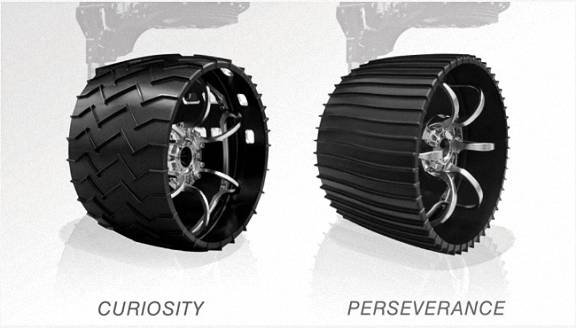
Illustrated here, the aluminum wheels of NASA’s Curiosity (left) and Perseverance rovers. Slightly larger in diameter and narrower, 20.7 inches (52.6 centimeters) versus 20 inches (50.8 centimeters), Perseverance’s wheels have twice as many treads, and are gently curved instead of chevron-patterned. April 03, 2020.
NASA/JPL-Caltech
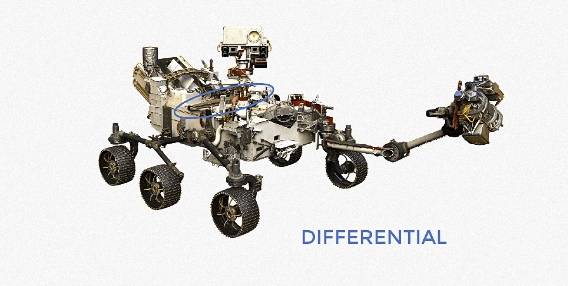
How the Wheels Move
Like NASA’s previous rovers, Perseverance uses a “rocker-bogie” suspension system . The suspension system connects the wheels to the rover and controls how the rover interacts with the Martian terrain.
Perseverance is designed to withstand a 45-degree tilt in any direction without tipping over. For added protection, rover drivers avoid terrains that would tilt the rover more than 30 degrees.
Rover Speed
By Martian vehicle standards, Perseverance is a standout. Its top speed on flat, hard ground is just under 0.1 mph (152 meters per hour). On Mars, it’s about the journey and destinations–not the speed. The energy-efficient slow pace consumes less than 200 watts, compared to nearly 150,000 watts for a 200-horsepower car.
|
Materials
|
Titanium tubing formed with the same process in high-end mountain bike frames.
|
|
Others
|
Enable the rover to drive over knee-high rocks up to 15.75 inches (40 centimeters).
|
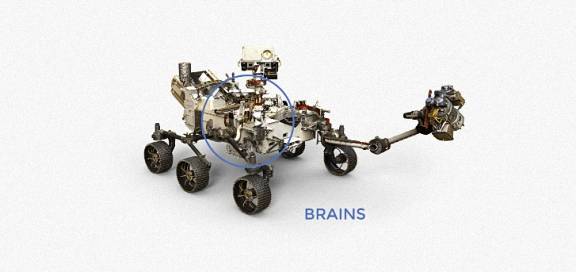
Brains
The rover’s brains – its computer – are in its boxy body. The computer module, the Rover Compute Element (RCE), has two identical RCEs so there is always a spare “brain.” The computer memory tolerates extreme radiation in space and on Mars. The RCE interfaces with the rover’s engineering functions over two networks that follow an aerospace industry standard for the high-reliability airline and spacecraft requirements. The RCEs directly interface with the rover instruments for command and science data exchange.
Tech Specs – Brains
|
Processor
|
Radiation-hardened central processor with PowerPC 750 Architecture: a BAE RAD 750
Operates at up to 200 megahertz speed, 10 times the speed in Mars rovers Spirit and Opportunity’s computers |
|
Memory
|
2 gigabytes of flash memory
256 megabytes of dynamic random access memory 256 kilobytes of electrically erasable programmable read-only memory |
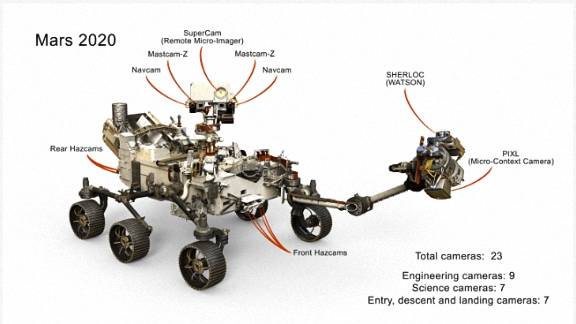
Eyes and Ears
Robots have replicated much of the human sensory experience on Mars. Cameras have given us sight, robotic hands, arms and feet have supplied touch, and chemical and mineral sensors have let us taste and smell on Mars.
Engineering Cameras
Several cameras for engineering and science tasks serve as eyes for driving, while others make science observations and help collect samples. robotic hands, arms and feet supply.
Entry, Descent, and Landing Cameras
Several cameras recorded stunning full-color views during the Perseverance entry, descent, and landing, including videos that provided invaluable data to help the team address such questions as how precisely the rover touched down in the landing area, how the landing system moved during landing, how much sand and rock the retro rockets blew into the Martian atmosphere, and how the landing system moves as it descends. These new eyes and ears of Perseverance were assembled from easily available commercial hardware. The cameras and microphone were an optional add-on.