
325-NASA Spacecraft Chamber of Horrors
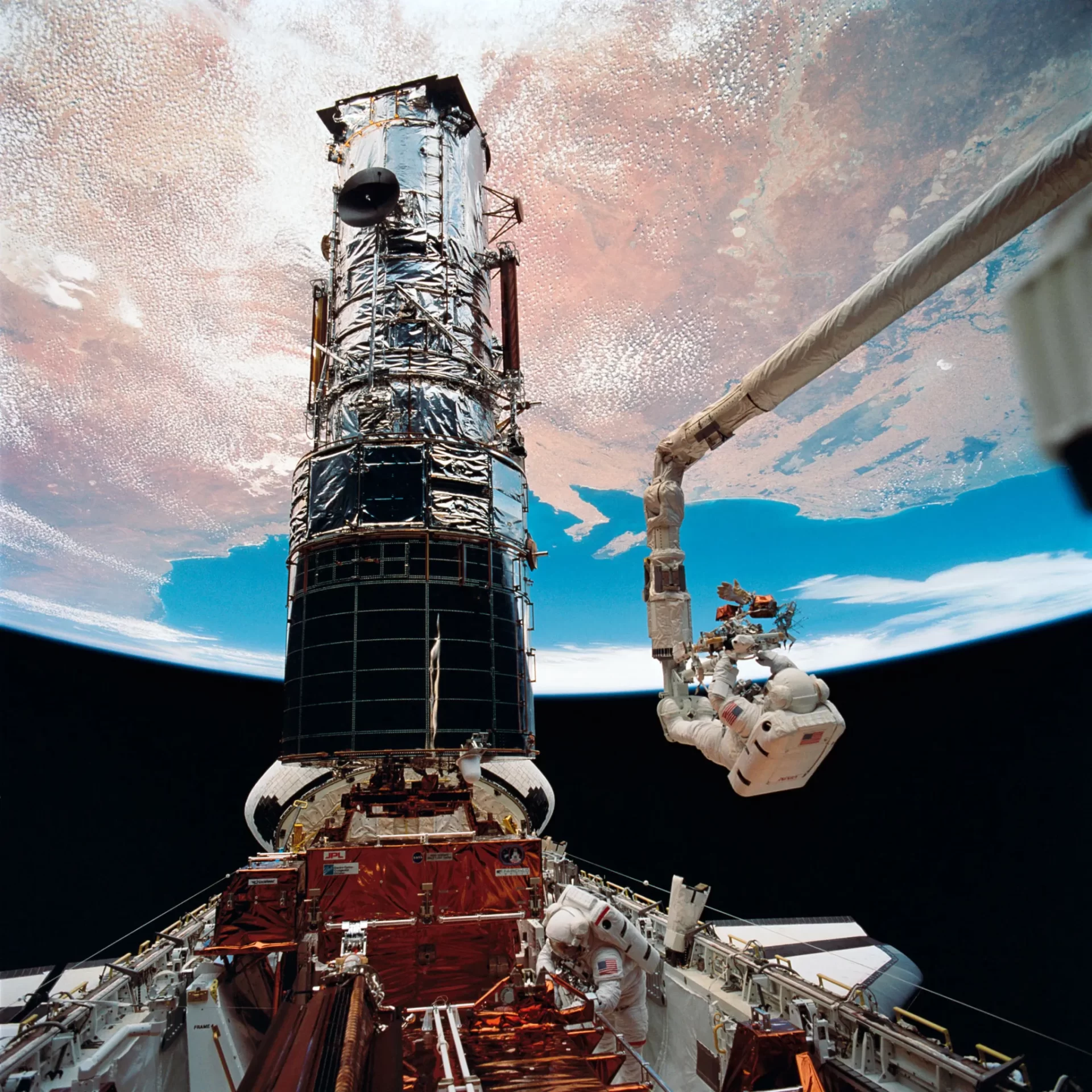
December 10, 1993 – Hubble Released Back Into Orbit
Astronaut Claude Nicollier used the Space Shuttle Endeavour’s robotic arm to release Hubble back into orbit so it could resume its explorations of the universe, now with much clearer vision.
To prepare for Servicing Mission 4, Hubble components must endure harsh tests at NASA’s Goddard Space Flight Center. This feature explores test facilities at Goddard like: launch phase simulator centrifuge, the acoustic test chamber, electromagnetic interference testing, vibration tables, static load test facility, and the space environment simulator.
The Hubble Space Telescope was reborn with Servicing Mission 4 (SM4), the fifth and final servicing of the orbiting observatory. During SM4, astronauts installed two new scientific instruments – the Cosmic Origins Spectrograph (COS) and Wide Field Camera 3 (WFC3). Two failed instruments, the Space Telescope Imaging Spectrograph (STIS) and the Advanced Camera for Surveys (ACS), were brought back to life by the first ever on-orbit repairs. These efforts brought Hubble to the apex of its scientific capabilities.
To prolong Hubble’s life, astronauts installed new batteries, new gyroscopes, a new science computer, a refurbished fine guidance sensor, and new insulation on three electronics bays. Additionally, astronauts attached a device to the base of the telescope that will facilitate de-orbiting when the telescope is eventually decommissioned.
Hubble Space Telescope. Hubble is the only telescope designed to be maintained in space by astronauts. Five Space Shuttle missions have repaired, upgraded, and replaced systems on Hubble.