
- This event has passed.
232-NASA – Wide Field Camera 3: Extending Hubble’s Vision
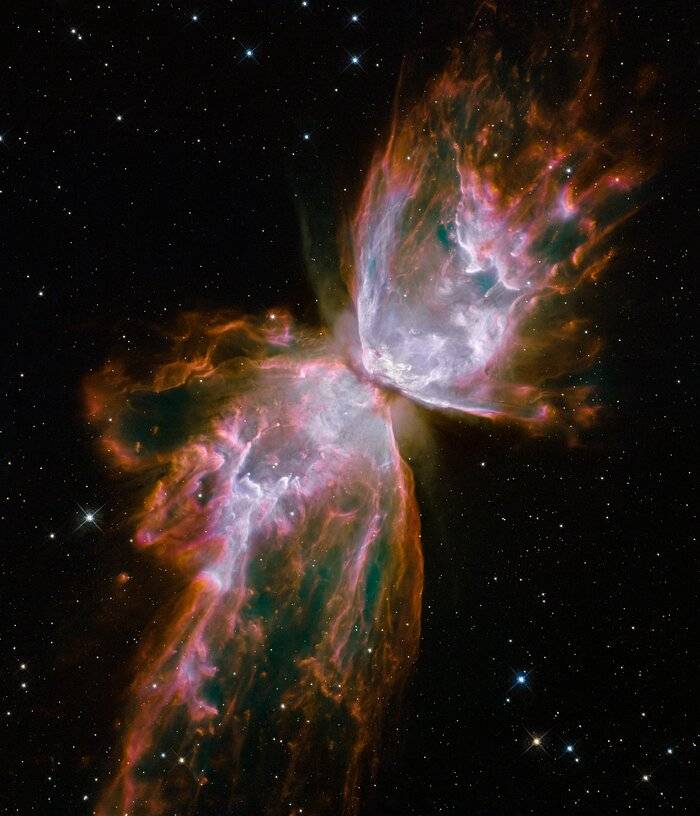
This celestial object looks like a delicate butterfly. But it is far from serene.
What resemble dainty butterfly wings are actually roiling cauldrons of gas heated to nearly 20 000 degrees Celsius. The gas is tearing across space at more than 950 000 kilometres per hour — fast enough to travel from Earth to the Moon in 24 minutes!
A dying star that was once about five times the mass of the Sun is at the centre of this fury. It has ejected its envelope of gases and is now unleashing a stream of ultraviolet radiation that is making the cast-off material glow. This object is an example of a planetary nebula, so-named because many of them have a round appearance resembling that of a planet when viewed through a small telescope.
The Wide Field Camera 3 (WFC3), a new camera aboard the NASA/ESA Hubble Space Telescope, snapped this image of the planetary nebula, catalogued as NGC 6302, but more popularly called the Bug Nebula or the Butterfly Nebula. WFC3 was installed by NASA astronauts in May 2009, during the Servicing Mission to upgrade and repair the 19-year-old Hubble.
NGC 6302 lies within our Milky Way galaxy, roughly 3800 light-years away in the constellation of Scorpius. The glowing gas is the star’s outer layers, expelled over about 2200 years. The “butterfly” stretches for more than two light-years, which is about half the distance from the Sun to the nearest star, Proxima Centauri.

This stunning spiral galaxy is Messier 100 in the constellation Coma Berenices, captured here by the NASA/ESA Hubble Space Telescope — not for the first time. Among Hubble’s most striking images of Messier 100 are a pair taken just over a month apart, before and after Servicing Mission 1, which took place 25 years ago in December 1993.
After Hubble was launched, the astronomers and engineers operating the telescope found that the images it returned were fuzzy, as if it were out of focus. In fact, that was exactly what was happening. Hubble’s primary mirror functions like a satellite dish; its curved surface reflects all the light falling on it to a single focal point. However, the mirror suffered from a defect known as a spherical aberration, meaning that the light striking the edges of the mirror was not travelling to the same point as the light from the centre. The result was blurry, unfocused images.
To correct this fault, a team of seven astronauts undertook the first Servicing Mission in December 1993. They installed a device named COSTAR (Corrective Optics Space Telescope Axial Replacement) on Hubble, which took account of this flaw of the mirror and allowed the scientific instruments to correct the images they received. The difference between the photos taken of Messier 100 before and after shows the remarkable effect this had, and the dramatic increase in image quality.
COSTAR was in place on Hubble until Servicing Mission 4, by which time all the original instruments had been replaced. All subsequent instrumentation had corrective optics built in.
This new image of Messier 100 taken with Hubble’s Wide Field Camera 3 (WFC3), demonstrates how much better the latest generation of instruments is compared to the ones installed in Hubble after its launch and after Servicing Mission 1.

Star clusters are common structures throughout the Universe, each made up of hundreds of thousands of stars all bound together by gravity. This star-filled image, taken with the NASA/ESA Hubble Space Telescope’s Wide Field Camera 3 (WFC3), shows one of them: NGC 1866.
NGC 1866 is found at the very edges of the Large Magellanic Cloud, a small galaxy located near to the Milky Way. The cluster was discovered in 1826 by Scottish astronomer James Dunlop, who catalogued thousands of stars and deep-sky objects during his career.
However, NGC 1866 is no ordinary cluster. It is a surprisingly young globular cluster situated close enough to us that its stars can be studied individually — no mean feat given the mammoth distances involved in studying the cosmos! There is still debate over how globular clusters form, but observations such as this have revealed that most of their stars are old and have a low metallicity. In astronomy, ‘metals’ are any elements other than hydrogen and helium; since stars form heavier elements within their core as they carry out nuclear fusion throughout their lifetimes, a low metallicity indicates that a star is very old, as the material from which it formed was not enriched with many heavy elements.
It’s possible that the stars within globular clusters are so old that they were actually some of the very first to form after the Big Bang.
When placed on the Hubble Space Telescope, WFC3 will provide unprecedented capabilities for imaging the cosmos at near-ultraviolet and at near-infrared wavelengths. The Wide Field Camera 3 (WFC3) will study a diverse range of objects and phenomena, from early and distant galaxy formation to nearby planetary nebulae, and finally our own backyard — the planets and other bodies of our Solar System. WFC3 extends Hubble’s capability not only by seeing deeper into the universe but also by seeing simultaneously into the infrared and ultraviolet. WFC3 can, for example, simultaneously observe young, hot stars (glowing predominantly in the ultraviolet) and older, cooler stars (glowing predominantly in the infrared) in the same galaxy.