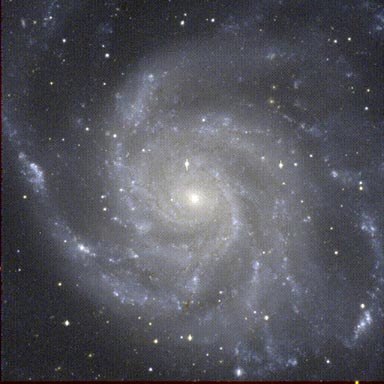
213-NASA – Pinwheel Galaxy

The galaxy Messier 101 (M101, also known as NGC 5457 and also nicknamed the Pinwheel Galaxy) lies in the northern circumpolar constellation, Ursa Major (the Great Bear), at a distance of about 21 million light-years from Earth. This is one of the largest and most detailed photo of a spiral galaxy that has been released from Hubble. The galaxy’s portrait is actually composed of 51 individual Hubble exposures, in addition to elements from images from ground-based photos.
Messier 101 is estimated to contain 1 trillion stars. Young and old stars appear to be evenly distributed along the galaxy’s spiral arms, as revealed by combined images of M101 in visible, infrared and X-ray wavelengths.
M101 is a comparable in size to the Milky Way. The disk is 100 billion solar masses, and the central bulge of about 3 billion solar masses. M101 is rich is pinkish star forming regions, many of which are very large and bright. Unlike most spiral galaxies, M101spiral shape is notably asymmetrical. This is due to the tidal forces from interactions with its companion galaxies. These gravitational interactions compress interstellar hydrogen gas, which then triggers strong star formation activity in M101’s spiral arms.