
- This event has passed.
194-Hubble Sees First-Time Icy Visitor Comet K2

The photo above and the time-lapse video below show NEOWISE as viewed from the International Space Station (ISS) on July 5, 2020. An astronaut shot more than 340 photos as the comet rose above the sunlit limb of Earth while the ISS passed over Uzbekistan and Central Asia.
NASA’s Hubble Space Telescope observed the farthest-discovered active inbound comet, Comet K2. K2 came from the distant Oort Cloud and is visiting our inner solar system for the first (and only) time. Since we’re seeing it so far away, past the orbit of Saturn, K2 is still in its early phase of activity, likely making it the most primitive comet anyone has ever seen.
Comet Neowise has a nucleus measuring roughly 5 kilometers (3 miles) in diameter, and its dust and ion tails stretch hundreds of thousands to millions of kilometers while pointing away from the Sun. The icy visitor was discovered on March 27, 2020, by NASA’s Near-Earth Object Wide-field Infrared Survey Explorer (NEOWISE) spacecraft as the comet was headed toward the Sun. The comet made its closest approach to the Sun on July 3, and then turned back toward the outer solar system.
Comets are made of frozen leftovers from the formation of the solar system roughly 4.6 billion years ago. The masses of dust, rock, and ice heat up when approaching the Sun; as they get closer, they spew gases and dust into a glowing head and tail. Satellite data indicate the NEOWISE has a dust tail and possibly two ionized gas tails. The comet is made visible by sunlight reflecting off of its gas emissions and dust tail.
“It’s quite rare for a comet to be bright enough that we can see it with the naked eye or even just with binoculars,” said Emily Kramer, a co-investigator of the NEOWISE satellite, in a NASA Science Live webcast. “The last time we had a comet this bright was Hale-Bopp back in 1995-1996.”
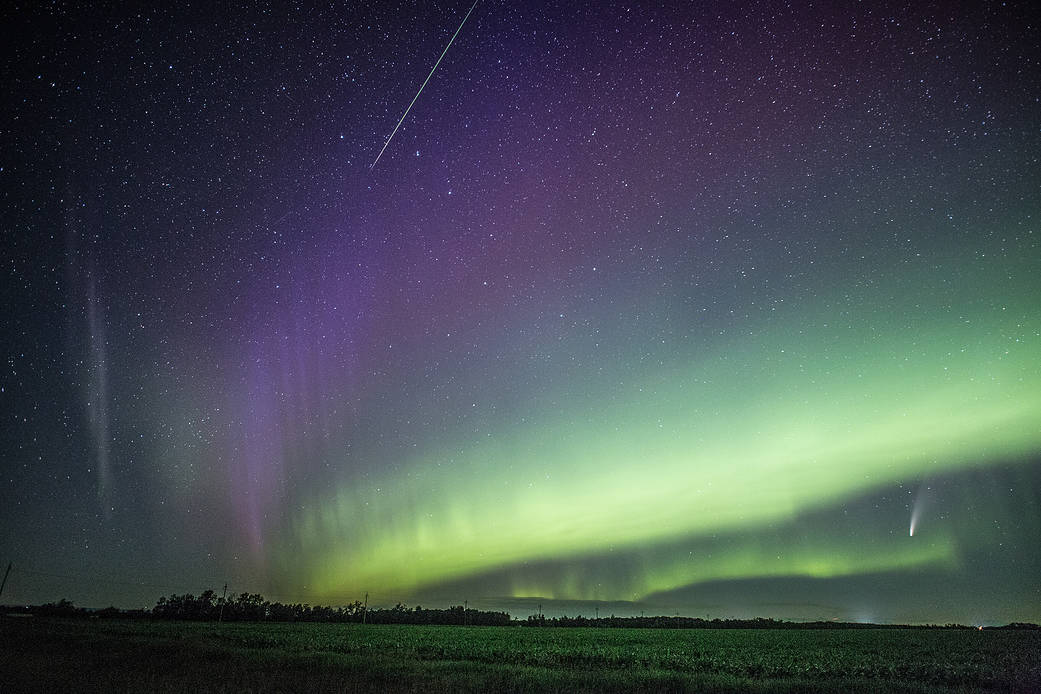
July 14, 2020
The photo above shows the comet (bottom-right) on July 14, 2020, against the backdrop of a green aurora in western Manitoba, Canada. The bright streak at the top is a meteor. The purple, ribbon-like structure is an aurora-like structure called STEVE (short for Strong Thermal Emission Velocity Enhancement), a phenomenon that was recently discovered with help from citizen scientists. Donna Lach, the photographer and an avid participant in the Aurorasaurus project, observed the scene for three hours and said the comet even out-shined the brilliant aurora at times.