
274-One Year on Earth – Seen From 1 Million Miles
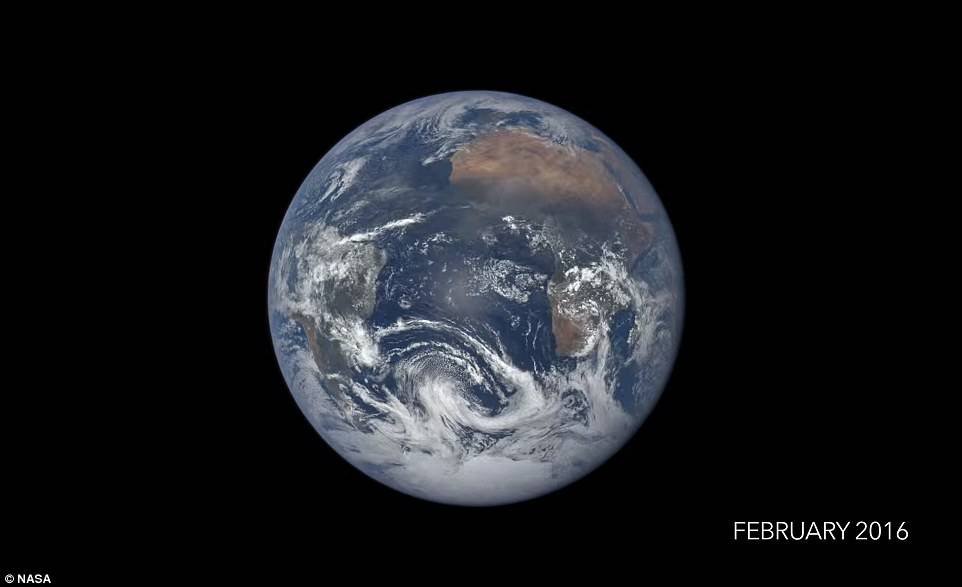
EPIC time lapse shows 1 year on Earth from a million miles away.
On July 20, 2015, NASA released to the world the first image of the sunlit side of Earth captured by the space agency’s EPIC camera on NOAA’s DSCOVR satellite. The camera has now recorded a full year of life on Earth from its orbit at Lagrange point 1, approximately 1 million miles from Earth, where it is balanced between the gravity of our home planet and the sun.
EPIC takes a new picture every two hours, revealing how the planet would look to human eyes, capturing the ever-changing motion of clouds and weather systems and the fixed features of Earth such as deserts, forests and the distinct blues of different seas. EPIC will allow scientists to monitor ozone and aerosol levels in Earth’s atmosphere, cloud height, vegetation properties and the ultraviolet reflectivity of Earth.
The primary objective of DSCOVR, a partnership between NASA, the National Oceanic and Atmospheric Administration (NOAA) and the U.S. Air Force, is to maintain the nation’s real-time solar wind monitoring capabilities, which are critical to the accuracy and lead time of space weather alerts and forecasts from NOAA.
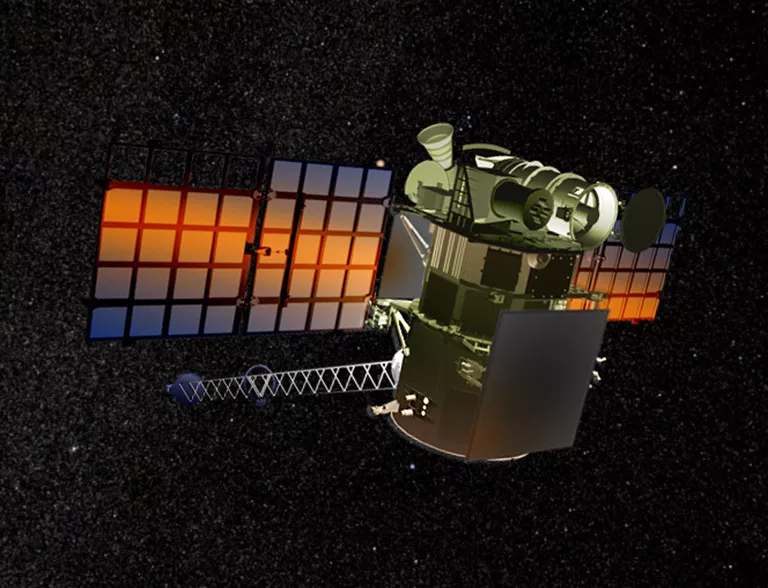
rtist’s rendering of the DSCOVR satellite
On June 27, 2019, issues with the satellite’s attitude control system prompted engineers to place DSCOVR into a “safe hold.” That maneuver halted the flow of all science observations, including imagery from NASA’s Earth Polychromatic Imaging Camera (EPIC). The high-powered camera takes full-disk images of the Earth used for global monitoring of clouds and vegetation, as well as atmospheric ozone and aerosols.
NOAA and NASA engineers developed a flight software patch to restore DSCOVR’s operations.