
- This event has passed.
221-NASA – Unusual Spiral Galaxy M66

Showing a large portion of M66, this Hubble photo is a composite of images obtained at visible and infrared wavelengths. The images have been combined to represent the real colors of the galaxy.
NASA, ESA and the Hubble Heritage (STScI/AURA)-ESA/Hubble Collaboration; Acknowledgment: Davide De Martin and Robert Gendler
Hubble has snapped a spectacular view of M 66, the largest “player” of the Leo Triplet, and a galaxy with an unusual anatomy: it displays asymmetric spiral arms and an apparently displaced core. The peculiar anatomy is most likely caused by the gravitational pull of the other two members of the trio.
The unusual spiral galaxy, Messier 66, is located at a distance of about 35 million light-years in the constellation of Leo. Together with Messier 65 and NGC 3628, Messier 66 is the member of the Leo Triplet, a trio of interacting spiral galaxies, part of the larger Messier 66 group. Messier 66 wins in size over its fellow triplets — it is about 100 000 light-years across.
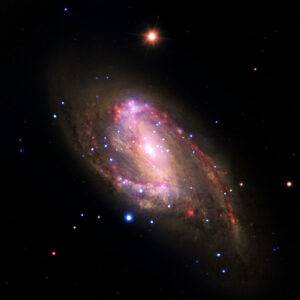
The spiral galaxy NGC 3627 is located about 30 million light years from Earth. This composite image includes X-ray data from NASA’s Chandra X-ray Observatory (blue), infrared data from the Spitzer Space Telescope (red), and optical data from the Hubble Space Telescope and the Very Large Telescope (yellow). The inset shows the central region, which contains a bright X-ray source that is likely powered by material falling onto a supermassive black hole.