
- This event has passed.
220-NASA – The Cigar Galaxy M82
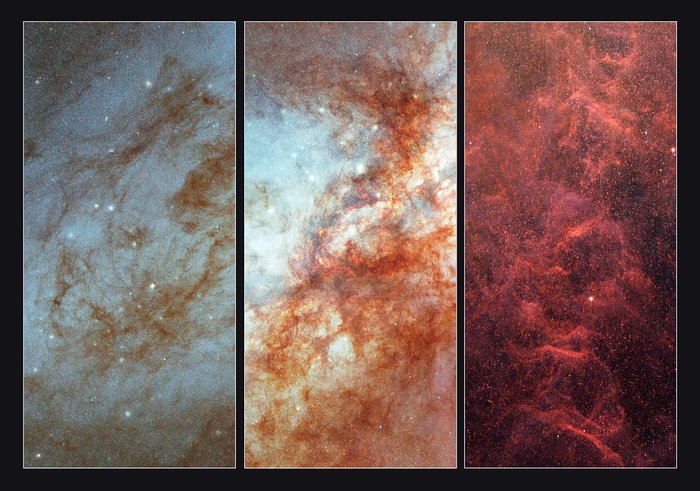
Messier 82 (M82), also known as the Cigar Galaxy, is an edge-on starburst galaxy located in the constellation Ursa Major. The galaxy lies at a distance of 11.4 to 12.4 million light years from Earth and has an apparent magnitude of 8.41.
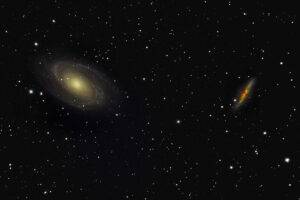
The star forming activity in M82 is caused by the galaxy’s interaction with its large neighbour, Bode’s Galaxy (M81), the central galaxy in the M81 Group, which also includes M82 and dozens of other galaxies in Ursa Major. The centres of the Cigar Galaxy and Bode’s Galaxy are visually separated by approximately 130,000 light years.
The Cigar Galaxy is strongly affected by the interaction with M81, with tidal forces deforming the galaxy in a process that started some 100 million years ago. As a result of the encounter, star forming activity in M82 has increased tenfold compared to other galaxies.
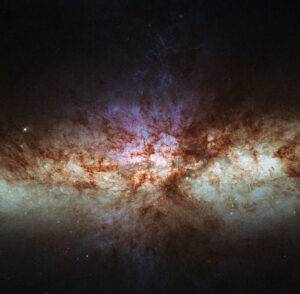
This image shows the most detailed view ever of the core of Messier 82 (M 82), also known as the Cigar Galaxy. Rich with dust, young stars and glowing gas, M 82 is both unusually bright and relatively close to Earth. The starburst galaxy is located around 12 million light-years away in the constellation of Ursa Major (The Great Bear).
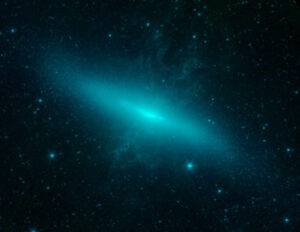
This image shows M82, also known as the “Cigar galaxy,” in infrared light, as observed by NASA’s Spitzer Space Telescope back in 2005. Image: NASA/JPL-Caltech.
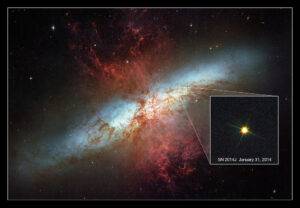
Spiral galaxy Messier 82 has long been known for its remarkable starburst activity, caused by interactions with its near neighbour Messier 81, and has been the subject of intense study for many years. On 21 January 2014, astronomers at the University of London Observatory in London, UK, pointed their telescope at the galaxy and spied something peculiar… an intensely bright spot seemed to have suddenly appeared within the galaxy. This bright spot is actually a new supernova known as SN 2014J — the closest supernova to Earth in recent decades!
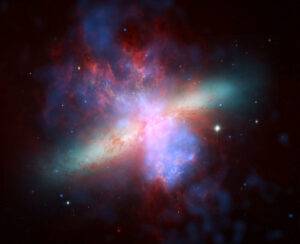
Messier 82. Composite of Chandra, HST and Spitzer images. X-ray data recorded by Chandra appears in blue; infrared light recorded by Spitzer appears in red; Hubble’s observations of hydrogen emission appear in orange, and the bluest visible light appears in yellow-green. Image: NASA/JPL-Caltech/STScI/CXC/UofA/ESA/AURA/JHU
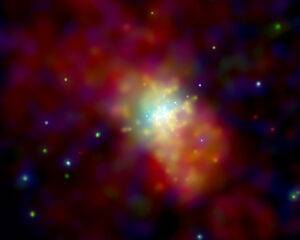
Composite image of the active galaxy M82 from x-ray observations by Chandra X-Ray Observatory in three energy bands coded in red (lowest energy x-ray photons), green, and blue (highest energy). Image: NASA/CXC/JHU/D.Strickland
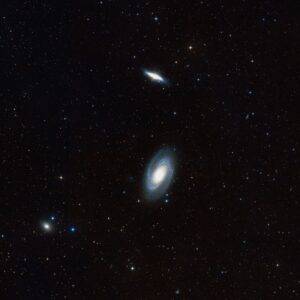
The galaxies M81, M82 and NGC 3077. Image: Wikisky